SEO has changed a lot over time. What used to work doesn’t always work now. In 2026, the focus is more on real value, user experience, and understanding what people actually want.
The problem is, many businesses still use old strategies or make simple mistakes without realizing it. And those small mistakes can quietly hurt your rankings.
If your website isn’t getting traffic or leads, it’s not always because SEO is too complicated. Usually, it’s because something is being done incorrectly.
In this guide, I’ll go over the most common SEO mistakes I’ve noticed—even from experienced people—and how you can fix them.
1. Ignoring What People Actually Want (Search Intent)
Let’s start with one of the biggest issues.
Many focus on keywords but forget why someone is searching in the first place.
For example, if someone searches “best laptops,” they probably want reviews or comparisons. But if they search “buy laptop online,” they’re ready to buy.
Now imagine writing a long blog when the user just wants to buy something. That won’t work well.
I’ve seen this mistake a lot, and it’s a major reason why some pages don’t rank.
What to do instead:
Before writing, search your keyword on Google and see the top results. That shows you the kind of content Google prefers.
Match that, and you’re ahead of many others.
2. Choosing the Wrong Keywords
Keyword research sounds simple, but many get it wrong.
Some go after highly competitive keywords and don’t rank. Others pick keywords nobody searches for.
Both waste time.
If you’re just starting or working on a business site, be smarter about this.
A better way:
Use specific, longer keywords.
Instead of “SEO services,” try:
“SEO services in Rawalpindi”
“affordable SEO for small business”
These are easier to rank for and bring more targeted visitors.
3. Weak Titles That Nobody Clicks
The title is the first thing people see. If it’s boring or unclear, they’ll move on.
It’s that simple.
I’ve seen sites with good content but bad titles—they don’t get clicks.
What works better:
Write titles that are clear and a bit interesting.
Instead of:
“SEO Guide”
Try:
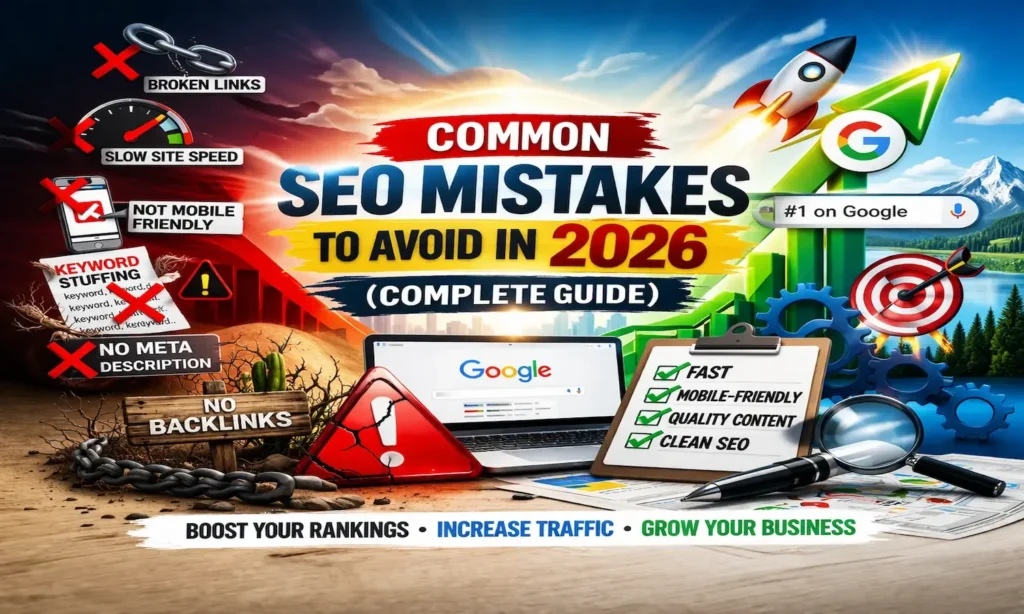
“Common SEO Mistakes to Avoid in 2026 (Complete Guide)”
Also, keep titles between 50–60 characters so they show properly.
4. Content That Doesn’t Really Help
Let’s be honest—there’s a lot of content out there that says a lot but doesn’t really help.
Google is smarter now. It can tell when content is just written to rank, not actually help users.
If your content is too short, too generic, or copied, it won’t do well.
What to focus on:
Write as if you’re really trying to help someone.
Explain things clearly. Use examples. Keep it useful.
If your content truly solves problems, it will perform better over time.
5. Not Thinking About Mobile Users
Most people browse on their phones now. If your site doesn’t work well on mobile, you’re losing many visitors.
Sometimes text is too small, buttons are hard to click, or the layout breaks.
People won’t wait—they’ll leave.
Quick fix:
Open your site on a phone and use it like a visitor. If anything feels off, fix it.
A smooth mobile experience matters a lot.
6. Slow Website Speed
If your site is slow, people won’t stick around.
When visitors leave quickly, Google notices.
Common causes are big images, poor hosting, or too many plugins.
How to improve:
Compress images, use good hosting, and keep your site clean.
Even small speed improvements can make a difference.
7. No Internal Linking
Many ignore this, but it helps a lot.
If your pages aren’t connected, users and search engines find it harder to navigate.
What you can do:
When you write a blog, link to other relevant pages on your site.
For example, if you mention SEO services, link to your services page.
This helps visitors explore more and boosts your SEO too.
8. Ignoring Technical Issues
Sometimes the problem isn’t your content but your website itself.
Broken links, missing pages, or indexing problems can stop your site from ranking.
The worst part is many don’t even know these issues exist.
What to do:
Check your site regularly. Fix errors. Make sure search engines can access your pages properly.
It’s not exciting, but it’s necessary.
9. Not Using Local SEO Properly
If your business operates in a certain area, you can’t ignore this.
People search things like:
“digital marketing agency near me”
“SEO services in Islamabad”
If you don’t optimize for local searches, you’re missing real customers.
What helps:
Use location-based keywords and keep your business profile updated.
Also, reviews matter more than you think.
10. Not Tracking What’s Working
Many just publish content and hope for results.
SEO doesn’t work that way.
If you don’t track your results, you won’t know what works and what doesn’t.
Simple tip:
Watch your traffic, rankings, and user behavior.
Once you see what’s working, you can focus more on that.
11. Leaving Old Content to Die
Publishing content is not a one-time thing.
Over time, info becomes outdated, competitors improve, and rankings shift.
If you never update your content, it loses value.
Better approach:
Go back to old blogs, update and improve them to keep them relevant.
This alone can boost your rankings without new content.
12. Trying to Force Keywords Everywhere
There was a time when repeating keywords helped. That time is over.
Now, it just makes your content awkward and hard to read.
What works now:
Write naturally.
Use your keywords where they make sense, but don’t force them.
If your content is clear and helpful, that’s enough.
13. Ignoring User Experience
At the end of the day, it’s all about the user.
If your site is confusing, cluttered, or hard to use, people won’t stay.
And if they leave, your rankings will drop.
Focus on:
Clean design, simple navigation, and making it easy for users to find what they need.
A good experience keeps visitors longer—and that helps SEO.
Conclusion
SEO in 2026 isn’t about tricks or shortcuts.
It’s about doing the basics well.
Know your audience, create helpful content, fix technical issues, and improve user experience—that’s what really works.
Avoid the mistakes we talked about and stay consistent, and you’ll start seeing results.
It won’t happen overnight, but it will happen.
Frequently Asked Questions
What is the biggest SEO mistake today?
Ignoring search intent. If your content doesn’t match what users want, it won’t rank.
Why is my website not getting traffic?
It could be poor keyword choice, weak content, or technical problems on your site.
How long does SEO take to work?
Usually, it takes a few months to see results depending on competition and strategy.